Angles, channels, beams, plates and pipe spools usually arrive at a fabrication yard as bare mill steel. If they sit unprotected in Oman’s heat, humidity and salt-laden air, rust starts within days. A shop-applied epoxy primer protects that steel from the moment it leaves our workshop until it is erected and top-coated on site. This guide explains how WAT Engineering primes structural steel sections: surface preparation, epoxy primer application, curing, and the safe loading and unloading that keeps the coating intact. We do this work in our Muscat workshop and on site in Duqm and Sohar.
Why prime steel sections in a workshop?
Priming in a controlled workshop gives better results than priming in the open on a construction site:
- Controlled conditions: we can blast, prime and cure under cover, away from wind-blown sand, dust and dew.
- Consistent quality: every piece gets the same surface preparation and film thickness, measured and recorded.
- Faster erection: steel arrives on site already protected, so the site crew only needs to touch up connections and apply the final coats.
- Lower cost: blasting and spraying loose sections on racks is quicker than working on steel once it is erected at height.
Materials we prime
Our team regularly primes:
- Equal and unequal angles
- Channels, I-beams, H-beams and hollow sections
- Steel plates, chequered plates and flat bars
- Pipe spools, supports and brackets
- Fabricated assemblies such as platforms, frames, skids, stair stringers and handrails
Galvanized steel, stainless steel and aluminium need a different surface preparation and primer. Tell us the material when you send your enquiry and we will recommend the right system.
Step 1: Inspection and surface preparation
Most coating failures start with poor surface preparation, so this is where we spend the most care.
- Receiving inspection: we check every piece for oil, grease, mill scale, heavy rust, weld spatter and sharp edges.
- Degreasing: oil and grease are removed with a suitable solvent cleaner before blasting, so they are not driven into the steel.
- Edge and weld preparation: sharp edges are rounded and weld spatter is ground off, because thin coating on sharp edges is where rust starts first.
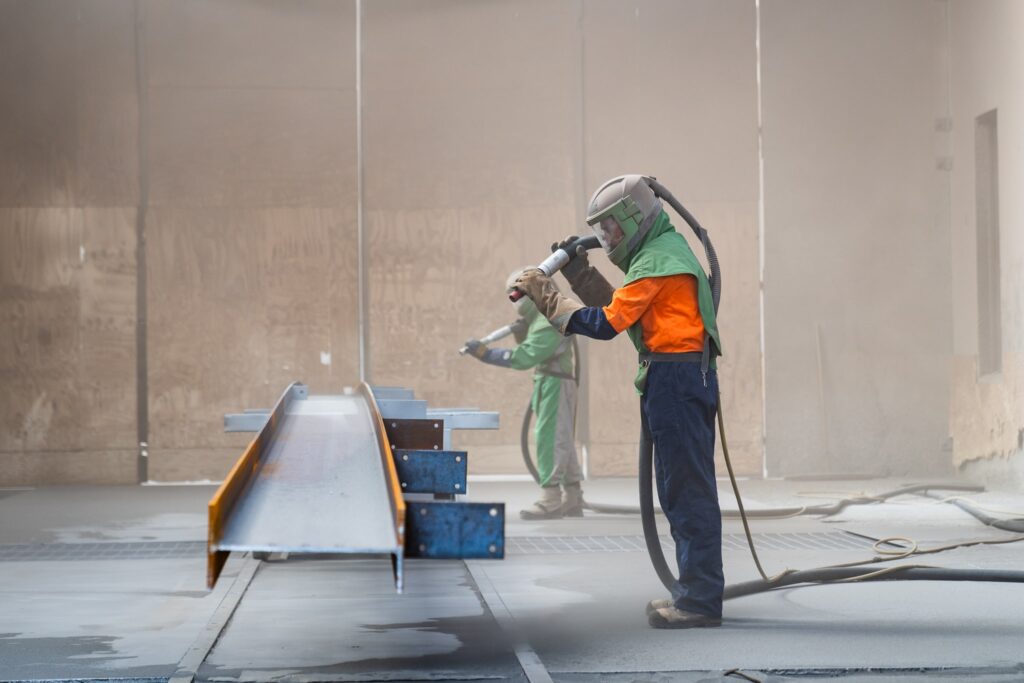
- Abrasive blasting: steel is blast cleaned to the grade the coating specification requires, typically Sa 2½ (near-white metal) to ISO 8501-1, with a surface profile that suits the primer. See our sandblasting and surface preparation services.
- Dust removal: blast dust is blown or vacuumed off before priming.
In Oman’s climate, freshly blasted steel can start to flash rust within hours, so we prime it the same day.
Step 2: Epoxy primer application
Epoxy primers are the standard choice for structural steel because they bond strongly to blasted steel and resist moisture and chemicals. Depending on the specification, we apply:
- Zinc-rich epoxy primers, which add galvanic protection and suit aggressive coastal and industrial sites;
- Epoxy zinc phosphate primers, a common general-purpose anti-corrosive primer;
- Surface-tolerant epoxy primers, for maintenance work where full blasting is not possible.
We work with systems from leading manufacturers such as Hempel and Jotun, applied to the paint maker’s data sheet and the project specification. Before and during spraying we check:
- Weather conditions: relative humidity, air temperature and steel temperature. Steel must be at least 3 °C above the dew point so moisture does not condense under the coating.
- Mixing: base and hardener are mixed in the correct ratio and used within their pot life.
- Stripe coats: edges, corners, bolt holes and welds are brush-coated first so they get full film thickness.
- Film thickness: wet film is checked during spraying, and dry film thickness (DFT) is measured and recorded once cured.
Step 3: Curing before handling
Epoxy primers need time to harden before the steel can be stacked or lifted. Moving steel too early is one of the most common causes of damaged primer. Curing time depends on the product, film thickness and temperature, so we follow the manufacturer’s “dry to handle” time and check the film before any piece is moved.
Step 4: Loading and unloading without damaging the coating
A perfect primer can be ruined in minutes by careless handling. Our handling practice for primed steel:
- Soft lifting: we use nylon or polyester webbing slings, never bare chain or wire rope directly on the coated surface.
- Spreader beams for long angles, channels and beams, so they do not bend or scrape during lifting.
- Timber dunnage and spacers between layers, so pieces never rest steel-on-steel and air can circulate.
- Secure transport: loads are tied down with protected straps and edge protectors so nothing shifts or rubs on the truck.
- Careful unloading on site: steel is set down on timber, never dragged across the ground, and stored off the sand.
Step 5: Inspection, records and touch-up
Every batch is inspected before dispatch. We record surface preparation grade, weather readings, batch numbers and DFT readings, so you have a clear quality record for your client or consultant. Any small handling damage is touched up with the same primer before it leaves the workshop, and we can supply touch-up material for site use.
Workshop or on site: Muscat, Sohar and Duqm
We prime steel in our workshop in Misfah, Muscat. For large projects, or where transporting steel is not practical, our team can carry out blasting and priming on site in Duqm and Sohar, as well as across the Muscat area. This suits fabrication yards, plant shutdowns and construction projects in Duqm’s Special Economic Zone and the Sohar industrial area.
Request a quote
To quote accurately we need the steel sections and quantities (tonnes or square metres), the coating specification or environment, and the location. Send us your details through our contact page or WhatsApp us on +968 7708 0212. Learn more about our protective coating services and steel fabrication.